Tina Bob Burger Again and Gain
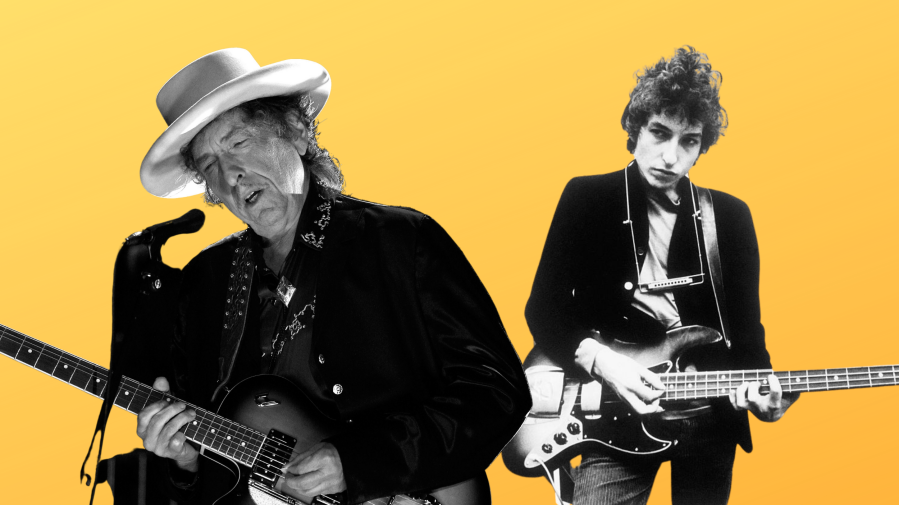
Bob Dylan is frequently referred to every bit the voice of a generation. Throughout his career, which has spanned more than than half a century, his lyrics have touched the hearts of millions. And his impact on the musical landscape has only get more undeniable. March 19 marks 60 years since the release of his start anthology, the eponymous Bob Dylan, and he's still enchanting audiences with his "freewheelin'" performances and the independent perspective that's defined his torso of work.
This icon has lived many lives in his decades-long career, and Dylan truly does "contain multitudes," as expressed on his 2020 studio anthology Rough and Rowdy Means. Throughout his many reincarnations, he's besides remained a symbol of spirited provocation. From bringing sensation to injustice around the world to encouraging people to look beyond themselves in the turbulent 1960s and today, Dylan continues to evangelize authenticity and invite marvel on tour and at rest. In celebration of these and other notable contributions he's fabricated to the worlds of music, civil rights, politics and even morality itself, we're taking a wait at The Bard's indelible legacy.
Dylan's Humble Ancestry Led Him to the Big Apple tree
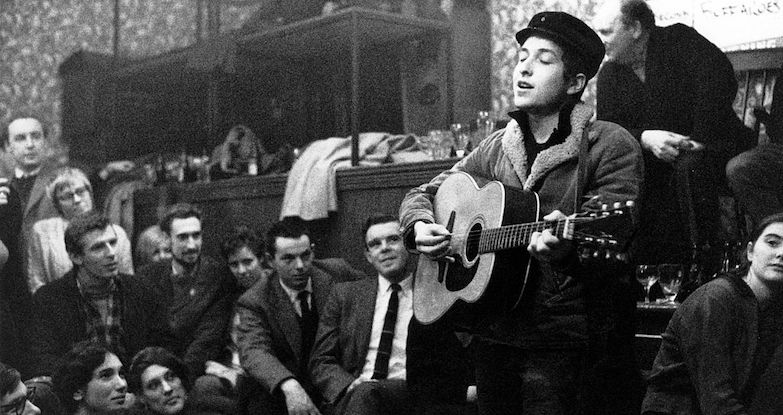
Born Robert Allen Zimmerman in 1941, Dylan'southward dearest thing with music began during his babyhood in Minnesota. Early on, legendary artists like Picayune Richard, Hank Williams and Woody Guthrie captured young Dylan's attention and led him to explore music more seriously. Throughout high school, he played with various bands, performing covers of Elvis and Niggling Richard songs while honing his skills on the guitar and piano.
In 1959, while studying at the University of Minnesota, he started to introduce himself as Bob Dylan, a name he chose later discovering works by the Welsh poet Dylan Thomas. By 1960 he'd become fully invested in learning more about Beat poesy and folk music, so he left school to pursue a new life in New York Metropolis — and hopefully connect with his ailing idol, Woody Guthrie, who was hospitalized nearby in New Jersey.
Similar many young artists, Bob Dylan was inspired past the rich culture of New York and began to connect with other musicians while developing his own style. After settling in the metropolis, he started performing at folk clubs in the Greenwich Hamlet neighborhood and was eventually spotted past a talent scout who signed him to Columbia Records.
In 1962 he released his debut cocky-titled album, which drew largely from the many influences he'd encountered up to that point. Unfortunately, it wasn't a commercial success — simply it was an important stepping stone. His second record, 1963'due southThe Freewheelin' Bob Dylan, was where his voice truly emerged, and it would exist this album that started to solidify his presence as a protest singer fighting for change. Long before the days of social media awareness campaigns, Dylan had begun to bandage a glaring low-cal on individual instances of injustice and racist violence while providing a soundtrack for a populace committed to changing the status quo.
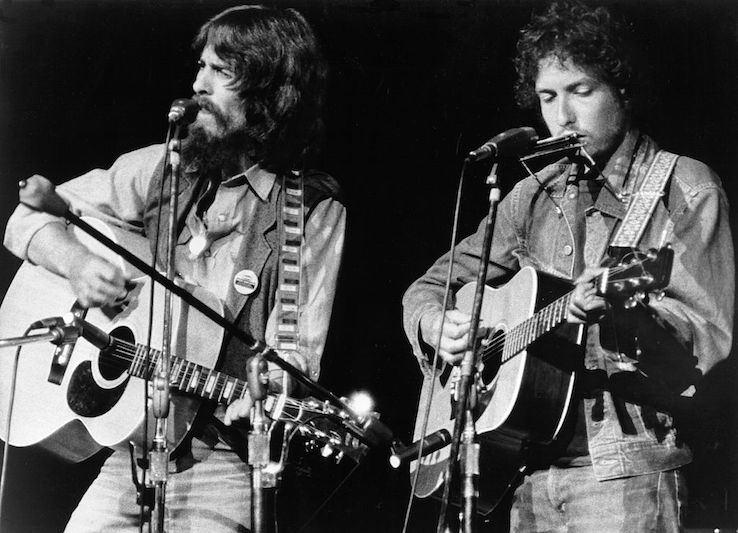
Bob Dylan boldly stood against oppression as an individual and an creative person, and this reputation defined much of his career. Through anti-war anthems like "Masters of War" and provocative inquiries like "Blowin' in the Air current," Dylan cemented himself as a thoughtful songwriter who refused to shy away from controversy. He performed at the 1963 March on Washington, and though he has never been interested in audience reverence for his positions on moral topics, his involvement in anti-state of war protests and the Civil Rights Movement helped to move the needle toward progress. "Yous couldn't help but feel the bike of history turning," Peter Koper, who saw Dylan perform live at the March on Washington, told The New York Times.
Always an innovator, Bob Dylan also changed the landscape of folk music in addition to challenging the institution. His early on rock influences and tendency toward innovation led him to create music that expanded the folk genre. In just i example, his experimentation with the electric guitar in 1965 was met with a mixed reception by the Newport Folk Festival oversupply. But that didn't stop him from pushing boundaries and creating music that authentically represents who he may be at whatever given moment, "whoever that is."
The Artist Remains a Living Legend
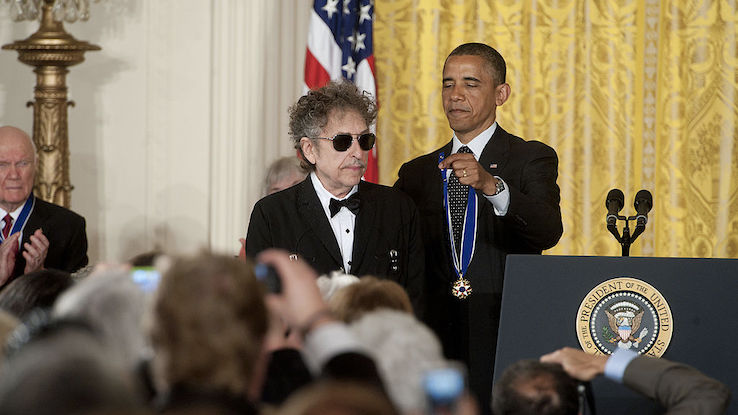
Though he famously rejected the title of poet — "I remember of myself more as a song and dance man, y'know," he in one case told reporters at a press briefing — and initially even rejected his Nobel Prize for Literature, his artistry seemingly knows no bounds. In improver to winning countless Grammy awards, this ever-evolving creative force is also an accomplished visual artist. Some of his pieces, which range from paintings to sculptures, tin be found on his personal website; The Guardian'southward Jonathan Jones has described them as "evocative celebrations of life itself." The largest drove of his drawings, paintings and sculptures to date, totaling over 100 original works, tin be plant at the Patricia & Phillip Frost Museum in Miami, Florida.
Since his first tape debuted six decades ago, Bob Dylan has released nearly 40 albums and shows no signs of hanging upward his guitar. And he's not just a musical legend. Though he is a well-decorated musician with such accolades as a Presidential Medal of Freedom, a Nobel Prize and countless other high honors, he'southward non divers by awards or his reputation. He continues to unfold and detect himself, fifty-fifty as the 60th ceremony of his time in the spotlight passes.
Bob Dylan truly embodies the thought of "loving the fine art in yourself, not yourself in the art" championed by the famed theater creative person Konstantin Stanislavski. His willingness to explore new artistic ideas and comprehend curiosity — and even chaos — highlights the power of the impulse to create, while his personal convictions gloat the brilliance and beauty of everyday people. As he continues his Never Ending Tour — which began in June of 1988 — nosotros'll keep waiting to see what "consummate unknowns" Dylan surprises us with next.
Source: https://www.ask.com/entertainment/bob-dylan-album-anniversary?utm_content=params%3Ao%3D740004%26ad%3DdirN%26qo%3DserpIndex
0 Response to "Tina Bob Burger Again and Gain"
Post a Comment