Fusing Peacock and Human Art Fusing Peacock and Human Facial Featuresart
On Looking at Jila Peacock's 10 Poems from Hafez
The book Ten Poems from Hafez includes Jila Peacock's calligraphy and new translations from the Farsi. A express handprint edition, with silkscreens on Japanese paper, was published in 2004 and is in the collections of the British Museum and the National Library of Scotland. A paperback version is published by Sylph Editions (world wide web.sylpheditions.com).
INorth THE Eye EAST, calligraphy is considered the highest of the arts. The Far East, too, despite its glorious tradition of mural painting, ranks calligraphy high higher up information technology. Contemporary artists in these nations are experimenting with their cultural legacies, and nowhere is this more brilliantly and beautifully practiced than in the calligraphic word-pictures of Jila Peacock. Peacock is an Iranian, born in that location, but taken to Britain as a child, and both languages seem native to her. She studied medicine in London; she too studied art, at the famous Saint Martins Schoolhouse. Both these arts she now practices in Glasgow, and has added a third, the fine art of translation.
The groovy Iranian national poet is Hafez, whose influence pervades their culture even more than Shakespeare does our ain. He lived earlier than Shakespeare, though, a contemporary of Chaucer and Dante, and of equal stature. Peacock has deepened her understanding of this poet by translating him. And she has gone further: she has chosen x poems in which some animal is meaning and—refining and perfecting an quondam Persian skill—created an prototype of the bird, fish, mammal, or insect using merely the words of the Hafez verse form. The letters are written in glorious Persian calligraphy: swirls, plenitudes, and crescendos creating a complication that to an Iranian is both legible and lyrical. An outsider cannot read the calligraphy, only respond to it.
Hafez was probably a Sufi. One has to say probably because our but certain biographical fact is that his name is non a nascence name only an honorary title, bestowed on i who could recite the holy Koran from memory in its entirety. He is a mystical poet (hence the likelihood that he was a Sufi of sorts—mystics all), and his theme is dear. The beloved he writes nearly can be taken on several levels, rather as in the biblical Song of Songs, where divine and human dear are one. Hafez describes the intoxication of wine and of prayer in ambivalent terms: the lower points to and rejoices in the higher [run into Plate 7].
§
Look at Peacock's Equus caballus [see Plate viii], with its proud and noble head, its elegant legs, near dancing with delight in life, its ears pricked for sound. The poem refers to the nightingale, the bulbul, and (as an example of her wit) the calligraphic signs for bulbul class the peaked curve of its two ears, cleverly communicating that this loftier-stepping animal listens to the nightingale while we picket. Peacock also draws the nightingale itself [run into Plate 9], trembling with passionate song, which the calligraphy renders with fragile emotion while the parted beak pours along "a mournful trill," in which "surged all his grief." Traditionally a nightingale is a symbol of intense love, felt past the bird for the rose. For the Sufi, the yearning soul is the nightingale, God himself the rose. Peacock's nightingale quivers with longing for the honey, as does the poet. The equus caballus as well is a love image, and the spiritual significance is for united states of america westerners peradventure deepened past our disability to decipher the Western farsi script of the ghazal, the love poem.
The significant becomes for us, literally, incomprehensible, as are all divine mysteries. Peacock uses nasta'liq script, the almost intricate of all Persian calligraphies, and she uses different colored pigments for her private works. She is known every bit a colorist, just here she has confined herself in each instance to a single tone: deepest dark-green, silver, or florescent pink, with peradventure just one dab of a contrasting color, as in the vivid carmine beak of the emerald parrot. The color is not capricious; in each case information technology is part of the full artwork. The butterfly, for example, glowing on the page, seems to shimmer in a luminous lift-off, so alive are its outstretched wings, each a mirror image of the other. The pure dazzler of the poetry is too essential to the full effect of the word-class. The peacock, a piece of work of stately magnificence, is composed of a longing lament that begins (at the bird's beak in Persian, which reads right to left) with a "yearning heart," "beingness" become "an illusion" because all reality is in the beloved who is absent [see Plate 10]. Toward the shut Hafez writes:
Your shadow falls across my frame,
Like the jiff of Jesus over withered bones.
We may stop, amazed, however Islam has always honored Jesus—not, it is true, as the son of God, but as holy prophet. Jesus in Standard arabic is Ruh Allah, which ways "spirit of God," the spirit (or breath) that raises the dead. The lovely inclusiveness of Islam, last historically of the iii swell religions, makes lamentable nonsense of political antagonism, just as Christianity's reverence for the Jewish Bible emphasizes the shame of anti-Semitism in and so-called Christians.
These works of profound seriousness and beloved, where meaning and prototype are married, and the love of God, which is love itself celebrated, are pure gift to our sad earth. Nosotros have the happy responsibility of responding to them. In reading the poems, so sensitively translated, we are fatigued into the dazzler of the calligraphic form, and in responding to the calligraphy, we come up nearer to the mystical truth of the poems.
O Hafez, rejoicing in the beauty of your pen,
We pass your precious words from center to heart.
§
When I wrote The Story of Painting, I spoke only of western painting, the whole lovely progression from Giotto to the present. Was I subconsciously afraid of eastern painting? At the conscious level, it never entered my mind. Simply later, through a dawning dear for ceramics, above all for the bang-up Sung bowls and the Tang tomb figures, I gained courage to explore what I belatedly realized is the greatest artistic tradition in the known earth. Again, it is the early art that fascinates me. (That "early" is a relative term in Communist china; they take works of majesty predating the pyramids.)
But it was not my love for eastern art that drew me to the piece of work of Jila Peacock. Rather, it was my ever-growing beloved for another art form, once again 1 I had unfairly neglected in my rash art-historical youth. This is the art of the icon, especially the 6th and seventh-century icons (few in number afterwards the years of iconoclasm). Information technology seems to me that Peacock's infinitely skillful calligraphy, as she spells out the lyrics of this mystic poet, has its rising in the same silence and prayer that are essential for the creation of an icon. Information technology is the attitude that makes a work religiously iconic, not the actual organized religion, though of course the incarnation of Christ, the actual course taken by the divine, is the validation of the icon painters' reverent attempts to make God visible, to unite the praying heart with what is pictured. Peacock does something of the same, I recall. Hafez yearns toward his God, and these word-forms are to his glory.
Khwajeh Shams al-Din Muhammad Hafez-eastward Shirazi
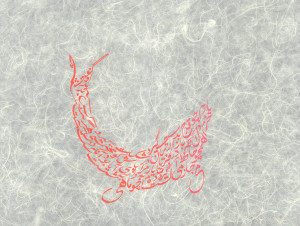
Plate 1. Jila Peacock. Fish, 2005. Ink on Paper. All images from the book Ten Poems of Hafez © Jila Peacock.
Fish
When my beloved offers the loving cup
Graven idols are crushed,
And those who gaze into that intoxicating middle
Call ecstatically for rescue.
I plunge into that ocean similar a fish
Craving the honey's hook,
I fall pleading at those anxiety
In hope of a helping hand.
Happy the heart who like Hafez
Is drunk with the vino of creation.
All translations by Jila Peacock.
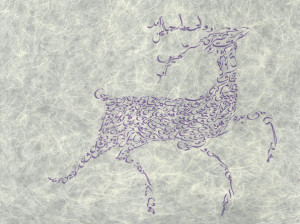
Plate two. Jila Peacock. Deer, 2005.
Deer
Dawn's bright awakening to my pillow called:
"Arise, your sweet Prince is come up.
Drain the cup and swaying see
How your lover manifest is come up.
Rejoice you lonely seeker of the scented path
For out of the wilderness the perfumed deer is come."
Sweet tears shall soothe the called-for cheeks once again
And sighs condolement the cries of unrequited lovers.
The bird in my heart with glory soars anew
Tremble poor dove for the falcon is come up.
Take comfort in the loving cup and banish fear of friend or foe
For the terminal has fled and the first is come.
The clouds of leap look downward on these troubled times
While bawling rains deliver daffodil and rose.
And hearing songs of Hafez from the nightingale
The scented zephyr, revelling, is come up.
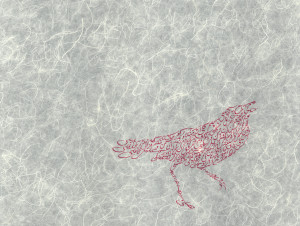
Plate 3. Jila Peacock. Nightingale, 2005. Ink on Paper.
Nightingale
Roaming the dawn garden to gather flowers,
I heard the cry of a nightingale.
Forlorn like me he loved the rose,
And in that mournful trill surged all his grief.
I wandered in the garden'southward timeless moment,
Balancing the plight of rose and bird.
For the rose is the heart of beauty,
And the nightingale, dazzler's slave;
The first may evidence no favor,
The second seeks no change.
And then stirring was his passionate song
That I was moved across endurance;
For countless roses flower each day,
Yet no man plucks a unmarried bloom
Without the risk of thorn.
O Hafez, seek no gain from the orbit of this wheel,
It has a thousand pitfalls and no respect for you.
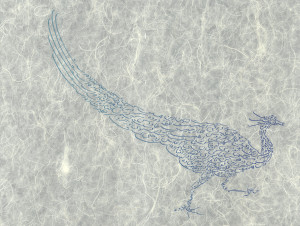
Plate iv. Jila Peacock. Peacock, 2005. Ink on Paper.
Peacock
Until your hair falls through the fingers of the breeze,
My yearning centre lies torn apart with grief.
Black as sorcery, your magic eyes
Render this existence an illusion.
The dusky mole encircled by your curls,
Is like the ink-driblet falling in the curve of J,
And wafting tresses in the perfect garden of your face,
Driblet like a peacock falling into paradise.
My soul searches for the comfort of a glance,
Light as the dust arising from your path.
Unlike the grit, this earthly body stumbles,
Failing at your threshold, falling fast.
Your shadow falls across my frame,
Like the breath of Jesus over withered bones.
And those who turn to Mecca as their simply haven,
Now at the knowledge of your lips tumble at the tavern door.
O precious love, the suffering of your absenteeism and lost Hafez
Roughshod and fused together with the ancient pact.
Source: https://imagejournal.org/article/the-intoxicating-eye/
0 Response to "Fusing Peacock and Human Art Fusing Peacock and Human Facial Featuresart"
Post a Comment